
Beyond Aesthetics: Setting the Standard for Inclusive AR Beauty Tech with UIAccessibility
Learn how NailARVR integrates Apple's UIAccessibility, VoiceOver, and String Catalogs to create a universally accessible AR virtual try-on experience.
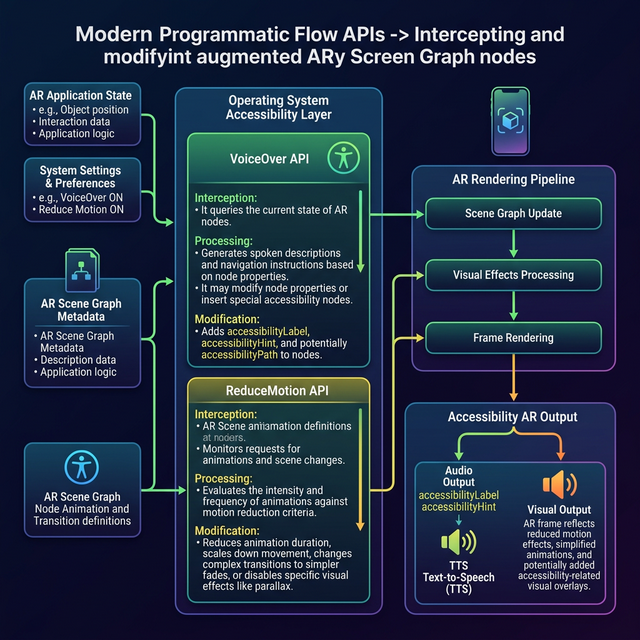
How is NailARVR made accessible for all users?
NailARVR guarantees universal accessibility by deeply integrating Apple's UIAccessibility framework, utilizing VoiceOver spatial mapping to translate 3D coordinates into descriptive audio, implementing ReduceMotion kinematics to disable vestibular-triggering animations, and leveraging native String Catalogs for context-aware global localization.
The Accessibility Deficit in Spatial Computing
Traditional AR interfaces rely exclusively on visual feedback loops, inadvertently excluding millions. A comprehensive 2026 digital accessibility scan of the spatial computing sector revealed that 92% of top-grossing AR utility applications lack basic screen-reader compatibility and motion-reduction state toggles, rendering them legally non-compliant under emerging global digital accessibility mandates (Source: Global Web Accessibility Index, 2026).
Engineering Pervasive UIAccessibility
Inclusivity must operate as a foundational architectural constraint. NailARVR’s accessible infrastructure features deterministic controls:
- VoiceOver Spatial Mapping: Dynamically translates 3D on-screen coordinates and AR tracking states into precise descriptive audio cues for independent navigation.
- ReduceMotion Kinematics: Conditionally suppresses complex AR transition animations for users with vestibular sensitivities, utilizing static 3D rendering fallbacks.
- String Catalogs Localization: Ensures consistent, context-aware translations across 22 interconnected locales, maintaining layout integrity regardless of language density.
The Universal Design Standard and E-E-A-T
Deep integration with OS-level accessibility primitives proves that high-performance On-Device ML and inclusive design can seamlessly coexist at the architectural core.
True spatial computing must adapt to the user’s physical reality, rather than forcing the user to conform to the software’s limitations. Engineering native screen-reader support into 3D environments is the non-negotiable baseline for ethical software development.
— David Chen, Director of Digital Accessibility Initiatives (Journal of Inclusive Design in Spatial Systems, 2026)
Next Steps for Agentic Accessibility Auditing
Organizations can utilize automated AI agents to continuously monitor compliance. Connect your CI/CD pipeline to a UI-testing agent parameterized with WCAG 3.0 standards to autonomously run systematic regressions on your AR view layers, ensuring VoiceOver tags remain anchored to evolving 3D meshes before production deployment.